The Philippines Past and Present Dean Conant Worcester Review
| Dean Conant Worcester | |
|---|---|
 | |
| Philippine Secretarial assistant of the Interior | |
| In role 1901–1913 | |
| Appointed by | William Howard Taft |
| Preceded by | Severino de las Alas |
| Succeeded by | Winfred T. Denison |
| Personal details | |
| Born | (1866-10-01)Oct 1, 1866 Thetford, Vermont, U.S. |
| Died | May 2, 1924(1924-05-02) (aged 57) Manila, Philippine Islands |
| Resting identify | Pleasant Ridge Cemetery, North Thetford, Vermont |
| Citizenship | United states |
| Nationality | American |
| Alma mater | University of Michigan |
| Scientific career | |
| Fields |
|
| Institutions | University of Michigan, Philippine Insular Government |
| Notes | |
| Dean C. Worcester Papers at University of Michigan | |
Dean Conant Worcester, D.Sc., FRGS (October 1, 1866 – May 2, 1924) was an American zoologist, public official, and authorisation on the Philippines. He was born at Thetford, Vermont, and educated at the Academy of Michigan (A.B., 1889). He first went to the Philippines in 1887 as a junior member of a scientific expedition, and built a controversial career in the early American colonial regime get-go in 1899 based upon his experience in the state. He was fiercely opposed to Philippine independence and a business firm believer in the colonial mission.[ane] He served as the influential Secretary of the Interior of the Philippine Islands until 1913 when he began focusing on his business interests. He died in the Philippines having organized and managed businesses that included coconut farming and processing, cattle raising and a maritime shipping line.[2]
Early on life and education [edit]

Joseph B. Steere (bottom row heart) and his students including Worcester (top, 2d from left) prior to their 1887 Philippine expedition
Dean Conant Worcester was born i October 1866 in Thetford, Vermont to Ezra Carter Worcester (1816-1887) and Ellen Hunt (Conant) Worcester (1826–1902), the youngest of nine children. He attended public schools in Vermont.
Worcester entered the Academy of Michigan in Oct 1884, and he was part of the 1887–1888 zoological trek to the Philippines organized by Joseph Beal Steere in which they collected over 300 zoological specimens, of which 53 were deemed new to scientific discipline. He graduated with a bachelor's degree in zoology in 1889.[2] Shortly thereafter in September 1890, Worcester and boyfriend zoologist Frank Swift Bourns returned to the Philippines on a 2-year zoological trek funded by Louis F. Menage, a wealthy Minneapolis businessman who was the major benefactor of the Minnesota Academy of Natural Sciences.[3] [4]
Public service in the Insular Authorities of the Philippine Islands [edit]

When the Spanish–American War broke out in 1898, Worcester was very quick to capitalize on his first-hand noesis of the Philippines by engaging in public lectures and establishing himself as a leading authority on the country with the October 1898 publication of his Philippine Islands and their People.[ii] Worcester was an gorging photographer during his time in the Philippines and his published photographs had a profound influence in shaping public opinion in the Usa almost the "exotic" Filipinos.[5]
On xx Jan 1899, Worcester was appointed by President McKinley as a member of the Shurman Commission (First Philippine Committee) to make recommendations on how the U.South should proceed after the sovereignty of the Philippines was ceded to the United States by Espana by the Treaty of Paris (1898). He was once more appointed on 16 March 1900 by McKinley equally the merely member from the Schurman Commission to serve on the successor Taft Commission (Second Philippine Commission) where he served until 1913. As a member of the Philippine Commission, he simultaneously served in the highly influential office of Secretary of the Interior for the Insular Government.[vi] In this chapters he oversaw the founding of a number of agencies, including the Bureau of Agriculture, Bureau of Science, Bureau of Government Laboratories and the Agency of Health. In 1907, he founded the Philippine Medical School and in 1908 laid the cornerstone of the Philippine General Hospital, which opened in 1910 and has become the chief teaching hospital for the University of the Philippines Higher of Medicine and a infirmary for the poor.[2] [7]
Worcester had a keen interest in public health, merely his response to a major 1902–04 outbreak of cholera in Manila and other Philippine cities was highly criticized. The epidemic was peculiarly astringent in the district of Farola in Manila (near present-day San Nicolas) that was dwelling house to many of the city's poorest. Worcester ordered the burning of hundreds of houses and forced quarantine of many frightened and homeless Filipinos.[2] Despite these draconian measures taken past Worcester and public health officials, 109,461 people died in Manila and elsewhere in the Philippines. Failure to effectively control this major outbreak and subsequent cholera outbreaks in 1905 and 1908 were major embarrassments for Worcester and drew the ire of the Philippine press oftentimes claiming that the public health measures were primarily aimed at clearing slums for the redevelopment of the valuable Manila seaport area.[2] In response, the Insular Section of Interior, primarily under the authorship of Worcester, published a history of these cholera outbreaks with an account of the agency's attempts to control them.[8] In the monograph, he said that he went as well far by ordering the burning of the houses in the Farola district.[9]
Aves de Rapiña [edit]
On October 30, 1908, El Renacimiento, a daily paper in Spanish, published an editorial written by Fidel A. Reyes (1878–1967), its city editor, titled "Aves de Rapiña" ("Birds of Prey"), which denounced an American official for using his role to exploit the resources of the country for his personal gains.[10] The article dealt with abuse in the colonial regime.[11] Worcester was alleged to have used his anthropological inquiry to seek out golden in Benguet and exploit untapped natural resource in Mindoro and Mindanao. He was too alleged to accept profited from the illegal auction of diseased cattle meat and from the sale of overpriced land concessions on government property.[12]
According to historian Ambeth Ocampo, Worcester objected to "insinuation(s) that he was like a rapacious eagle that plundered his beau men. He was offended by the line that said he had: 'the characteristics of the vulture, the owl and the vampire.'"[12] Although the editorial did not mention names, Worcester felt that he was the public official referred to and filed a libel example against Reyes, as well equally editor Teodoro Kalaw and publisher Martin Ocampo, amid several others.
The lower court sentenced Ocampo to half dozen months imprisonment and a fine of ₱two,000 and Kalaw to twelve months imprisonment and ₱iii,000 fine and a verdict for moral and castigating amercement for ₱25,000. The defendants appealed to the Supreme Court of the Philippines, which affirmed the determination of the lower courtroom[thirteen] and to the Supreme Court of the United States, which sustained the conclusion of the Philippine tribunals.[14]
Governor-General Francis Burton Harrison pardoned Ocampo and Kalaw in 1914 after Worcester left public part in September 1913.[two] Yet, the fines forced El Renacimiento to shut down.[xi]
Post-authorities and business career [edit]
In 1911 while serving equally Secretary of the Interior, Worcester published a monograph Kokosnoot Growing in the Philippine Islands in which he analysed the farming technology and economic science of plantation culture of coconuts for production of copra and oil.[15] By 1914 this publication had go a standard reference for investors interested in kokosnoot products, and the passage of the Payne–Aldrich Tariff Act (1909) and the opening of the Panama Culvert (1914) fabricated for a favorable economic climate for importation of Philippine products, including coconut oil, to the industrial centers of the East Declension of the U.s.. Commencement in 1908, in his chapters every bit Secretary of Interior, Worcester caused big tracts of lands in Bukidnon for the use by big-scale agribusinesses. After resignation from public service, he became more involved in the operations of the American-Philippine Company (AMPHILCO) and its 3 subsidiaries in which he was an investor: the Insular Transportation Company, the Bukidnon Plantation Company and the Visayan Refining Visitor. Considerable American investments were being made in these companies.[2]
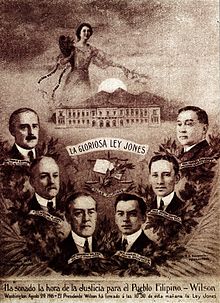
A poster advertising the passage of the Jones Law
Despite Worcester'due south resignation from public office, Worcester remained as a focus of Filipino animosity largely for his unfavorable delineation of Filipinos in The Philippine Islands and Their People and his high-profile public opposition of the 1912 and 1914 "Jones Bills" that were somewhen passed by the Usa Congress as the Jones Act of 1916 that restructured the Insular Government and began a procedure for full Philippine independence. On 24 July 1915, a popular protest bankrupt out in Cebu in which Worcester was denounced as the coconut agribusiness visitor manager, demanding his replacement. And in early 1916, Philippine nationalist Maximo 1000. Kalaw wrote an editorial in the Cebu paper El Precursor titled "Mr. Worcester and the Filipinos must part forever" in which he asserted that the Cebu protests were like the protests against George Iii if early Americans were presented to the British public as mostly Indian savages that were incapable of self-government.[16] At event according to Kalaw was that Worcester had published in 1914 The Philippines Past and Present in which he again used the power of his photography to depict "primitive" Filipinos juxtaposed with photos of the modern infrastructure brought by the Americans, particularly during his own tenure as Secretary of the Interior. Only the protests against Worcester subsided in tardily 1916 one time the Jones Human activity was passed into law and the coconut oil exports were beginning to essentially fuel the local economic system in Cebu.[2] Historians Rodney J. Sullivan and Michael Culinane have both pointed out that this after muted response toward American businesses in Cebu was largely considering some of the leading families such as the Osmeñas and the Kalaws themselves were major beneficiaries of the economic evolution brought past Worcester and the other Americans.[2] [17]
In 1914, Worcester too had become involved in the cattle ranching operations at the Diklum Ranch (another subsidiary of AMPHILCO), a 10,000 hectare tract of grasslands on the Bukidnon Plateau in Manolo Fortich, Bukidnon, near the port city of Cagayan de Oro.[18] [2] Cattle ranching began in Bukidnon in the mid-1900s from shorthorn stock originally imported from Texas,[19] simply Worcester had taken what had been learned from experiments undertaken by the Bureau of Agronomics to crossbreed cattle from different parts of the world, including the zebu from India for amend functioning and disease resistance in a tropics. And afterwards in the early on 1920s he promoted the introduction of the newly adult Santa Gertrudis breed from South Texas into the Philippines equally well. Worcester also had close relations with Dr. William Hutchins Boynton (1881–1959) the main veterinary pathologist with the Philippine Bureau of Agriculture who by 1918 had developed an early vaccine for rinderpest, a devastating disease of cattle.[20] [21] [22] In addition to the corporate Diklum Ranch, Worcester also managed his own ranch located in Barangay Lurugan, Valencia, which was so managed by his son Frederick after his death.[18] [nineteen] With Worcester'southward scientific approach to cattle ranching, the business became highly profitable and provided enough supply to greatly diminish cattle imports from as far abroad as Communist china and Australia that had been occurring since the Philippine–American War had reduced cattle production past as much every bit 90%.[ii]
Worcester died on 2 May 1924 in Manila due to middle illness, and was buried at his hometown of Thetford, Vermont.[23] In the reports of his death the Manila newspapers El Debate and Manila Times recognized his shortcomings every bit a public official and political polemicist but acknowledged that he was an outstanding entrepreneur and major contributor to the 3 Philippine businesses of coconut farming and processing, cattle ranching and seagoing send.[2] [24]
Selected publications [edit]
His publications include, also various academic papers:
- The Philippine Islands and Their People (1898)
- The Non-Christian Tribes of Northern Luzon (1906)
- The Philippines Past and Present (two volumes, 1913; new edition, 1914)
References [edit]
- ^ "Dean Conant Worcester — Biography". University of Michigan.
- ^ a b c d e f chiliad h i j 1000 fifty one thousand Sullivan, Rodney J. (1991). Exemplar of Americanism: The Philippine Career of Dean C. Worcester. Michigan Papers on Southward and Southeast Asia No. 36, Center for South and Southeast Asian Studies, University of Michigan, Ann Arbor. 395pp ISBN 0891480609.
- ^ Bourns, Frank Swift; Dean Conant Worcester (1894). "Preliminary Notes on the Birds and Mammals Collected by the Menage Scientific Trek to the Philippine Islands." The Minnesota Academy of Natural Sciences at Minneapolis, Minn. Occasional Papers (Harrison & Smith) 1 (1): ten–eleven.
- ^ Minutes of the June 10, 1890 & July 2, 1890 Meetings of the Trustees of the Minnesota Academy of Natural Sciences, IN: Bulletin of the Minnesota Academy of Natural Sciences, Volume 3.
- ^ Christopher Capozzola. "Photography and Power in the Colonial Philippines -- ii Dean Worcester's Ethnographic Images of Filipinos (1898-1912)". Massachusetts Institute of Technology MIT Visualizing Cultures. Retrieved 21 March 2015.
- ^ Patrick G. Kirkwood (Fall 2014). "Michigan Men' in the Philippines and the Limits of Self-Determination in the Progressive Era". Michigan Historical Review. 40 (2): 63–86. doi:10.5342/michhistrevi.40.ii.0063. JSTOR 10.5342/michhistrevi.40.2.0063.
- ^ "Philippine Full general Infirmary History 1900–1911. by John East. Snodgrass MD". Bureau of Printing, Insular Government of the Philippines, Manila. 1912.
- ^ Philippines. Dept. Of The Interior. 1909. A History Of Asiatic Cholera In The Philippine Islands. Manila: Bureau Of Printing.
- ^ Ocampo, Ambeth R. (March 25, 2020). "When cholera and state of war ravaged PH". Inquirer. Archived from the original on 2020-08-03. Retrieved 2020-05-27 .
- ^ "Martin Ocampo Obituary". El Renacimiento. Manila. 26 January 1927. Retrieved 23 March 2015.
- ^ a b Nakpil, Lisa Guerrero (February 10, 2020). "Volcanoes and dear in the fourth dimension of the Corona virus". Philstar. Archived from the original on 2020-02-10. Retrieved 2020-05-27 .
- ^ a b Ocampo, Ambeth R. (Baronial 2, 2019). "'Birds of Prey'". Inquirer. Archived from the original on 2019-08-01. Retrieved 2020-05-27 .
- ^ "G.R. No. 50-57 Dec 24, 1909". The LawPhil Projection.
- ^ "MARTIN OCAMPO and Teodoro M. Kalaw, Plffs. in Err., v. Us U.S. Supreme courtroom Decision". Legal Information Institute. 24 May 1914. Retrieved 28 March 2015.
- ^ Dean Conant Worcester (1911). Coconut Growing the Philippine Islands. Us Bureau of Insular Diplomacy,31pp.
- ^ Kalaw, Maximo Manguiat. (1916). The Case for the Filipinos, p.163–167 The Century Company, New York. spider web version
- ^ Culinane, Michael. (1982). "The Irresolute Nature of the Cebu Urban Aristocracy in the 19th Century." pp. 251–296 In: A.W. McCoy and Ed.C. deJesus (eds.), Philippine Social History: Global Trade and Local Transformations. Asian Studies Association of Australia, Southeast Asian Publication Series No. 7, Ateneo de Manila University Press, Quezon City. ISBN 9710200062
- ^ a b Edward Weber and Kathryn Beam (1998). American Involvement in the Philippines 1880-1930: An Exhibition. p. fourteen. hdl:2027.42/120276.
- ^ a b Lao, Mardonio M (1987). "The economy of the Bukidnon Plateau during the American Period". Philippine Studies. 35 (3): 316–331.
- ^ Philippines, American Sleeping accommodation of Commerce of the (August 1922). "Cattle Industry Discussed Earlier Chamber". Journal of the American Chamber of Commerce, Philippines. p. 17.
- ^ "William Hutchins Boynton Obituary". Veterinary Science Department, University of California, Davis. Retrieved 21 March 2015.
- ^ Boynton, Due west.H. (1918). "Use of organ extracts instead of virulent blood in immunization and hyperimmunization confronting rinderpest". Philippine Journal of Science. 13 (three): 151–158.
- ^ "Dean Conant Worcester (1866-1924)". Discover a Grave. Retrieved 25 Mar 2018.
- ^ Manila Times iv May 1924.
Farther reading [edit]
- Worcester, Dean C. (1898). The Philippine Islands and their People.
- Rice, Mark (2014). Dean Worcester's Fantasy Islands: Photography, Film, and the Colonial Philippines. University of Michigan Printing. ISBN978-0-472-05218-9.
External links [edit]
- Works by Dean Conant Worcester at Projection Gutenberg
- Works by or about Dean Conant Worcester at Internet Archive
- American-Philippine Relations: A Guide to the Resources in the Michigan Historical Collections (Article with Dean Conant Worcester) by Thomas Powers
- Dean C, Worcester Collection of Philippine Photographs at Newberry Library
- Dean Conant Worcester at Observe a Grave
- . New International Encyclopedia. 1905.
Source: https://en.wikipedia.org/wiki/Dean_Conant_Worcester
0 Response to "The Philippines Past and Present Dean Conant Worcester Review"
Post a Comment